Spaces of Prayer and Sensory Experience: The Boim and Kampiany Chapels in Early Modern Lviv
Research Area 3: Objects, Traces, Mapping: Everyday Experience of Spaces
Contact: stephanierom07@gmail.com
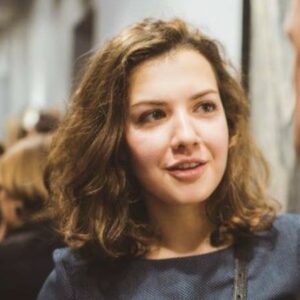
Stefaniia Demchuk, an art historian and Associate Professor at the Department of Art History of Taras Shevchenko National University of Kyiv, joins CEFRES for the 2026–2027 academic year. She is also Editor-in-Chief of the scholarly journal Text and Image: Essential Problems in Art History and co-leader of the “Materialities” Working Group within the COST Action Print Culture and Public Spheres in Central Europe, 1500–1800. Her research focuses on early modern art and visual culture in Central and Eastern Europe, the historiography and theory of art, the circulation of artistic forms across cultural and confessional boundaries, and the relationship between images, materiality, and religious experience. Drawing on approaches from entangled and horizontal art history, intermediality studies, and sensory and material culture studies, her work seeks to situate the art of present-day Ukraine within wider European networks of exchange.
Her publications have addressed the reception of the Vienna School of Art History in Soviet and post-Soviet scholarship, the historiography of Mannerism, religious imagery and Eucharistic controversy during the Reformation, gastronomic motives in early modern Netherlandish art, and the decolonisation of Ukrainian art history. She is co-editor, with Illia Levchenko, of Entangled Art Histories in Ukraine (Routledge, 2025) and the author of Stillleben mit Agave: Alexis Gritchenko (Staatliche Kunstsammlungen Dresden, 2024). Her current research also explores early modern devotional imagery and practices, Antwerp Mannerism, and the intersections between food, visual culture, and social history.
During her fellowship, she will develop the project Spaces of Prayer and Sensory Experience: The Boim and Kampiany Chapels in Early Modern Lviv. The project examines two major late sixteenth- and early seventeenth-century chapels as spaces designed to shape devotional practice, sensory perception, and encounters between the living and the dead. It asks what visitors were expected to see and experience and how architecture, sculpture, inscriptions, light, colour, materials, textures, and devotional texts worked together to guide attention, movement, memory, and affect. Combining spatial and iconographic analysis with archival research, early modern descriptions of Lviv, and comparative examples from Western and Central Europe, the project places these monuments within the multicultural and multi-confessional environment of early modern Lviv and within broader networks through which Renaissance artistic and architectural forms circulated, were adapted, and acquired new local meanings.
CV
Education
2016: PhD in History, Taras Shevchenko National University of Kyiv
2012: MA in History, Taras Shevchenko National University of Kyiv
2010: BA in History, Taras Shevchenko National University of Kyiv
Awards and research funding
2025: Max Weber Foundation International Research Award
2024–2025: Bibliographical Fellowship, William Andrews Clark Memorial Library, University of California, Los Angeles
2024: Historians of Netherlandish Art Fellowship for a research stay in Brussels and Bruges
2023: Getty Library Research Grant, Getty Research Institute, Los Angeles
2023: Coimbra Group Research Fellowship, KU Leuven
2022–2024: Research Fellowship, Department of Art History, Masaryk University, Brno
2019: Joint Excellence in Science and Humanities Fellowship, Austrian Academy of Sciences, Vienna
Employment history
Since 2023: Associate Professor, Department of Art History, Taras Shevchenko National University of Kyiv
Since 2023: Part-time Lecturer, Kyiv School of Economics
2022–2024: Research Fellow, Department of Art History, Masaryk University, Brno
2017–2023: Assistant Professor, Department of Art History, Taras Shevchenko National University of Kyiv
2016–2017: Junior Research Fellow, Faculty of History, Taras Shevchenko National University of Kyiv
Professional experience
Since 2026: Editor-in-Chief of the scholarly journal Text and Image: Essential Problems in Art History
Since 2024: Co-leader of Working Group 4, ‘Materialities’, COST Action CA23137, Print Culture and Public Spheres in Central Europe, 1500–1800
Since 2023: Teaching at the Kyiv School of Economics
International research experience
2024–2025: William Andrews Clark Memorial Library, University of California, Los Angeles
2024: Research stay in Brussels and Bruges, supported by Historians of Netherlandish Art
2023: Getty Research Institute, Los Angeles
2023: Department of Art History, KU Leuven
2022–2024: Department of Art History, Masaryk University, Brno
2019: Institute for Modern and Contemporary Historical Research, Austrian Academy of Sciences, Vienna
Selected publications
Demchuk, Stefaniia, and Illia Levchenko, eds. Entangled Art Histories in Ukraine. London and New York: Routledge, 2025.
Demchuk, Stefaniia. Stillleben mit Agave: Alexis Gritchenko. Dresden: Staatliche Kunstsammlungen Dresden, 2024.
‘Words for Pictures: Ekphrasis as a Heuristic Tool in Alois Riegl’s Art History.’ Edgar Wind Journal 9 (2025): 74–88. https://doi.org/10.53245/EWJ-00048.
With Illia Levchenko. ‘Decolonizing Ukrainian Art History.’ Nationalities Papers (2024): 1–25. https://doi.org/10.1017/nps.2024.58.
‘Food, Family, and the Reformation: From Family to Banquet Portrait in the Art of Early Modern Netherlands’ (in Ukrainian). Ukrainian Historical Review (2023), Vol. 2, 61 – 80.
With Illia Levchenko. ‘Ukrainian Baroque: Art, Myth, and National Identity.’ Histoire de l’art 91 (2023): 85–96.
‘The Mannerist “Revolution”, Dvořák and Soviet Art History.’ Journal of Art Historiography 25 (2021): 1–15.
‘The Influence of the Vienna School of Art History on Soviet and Post-Soviet Historiography: Bruegel’s Case.’ Journal of Art Historiography 23 (2020): 1–19.
‘Two Suppers: Illustrations by Jacob Cornelisz. van Oostsanen to Passio Domini Nostri Jesu Christi (1523) and the Eucharistic Controversy of the Early Reformation.’ Modus: Prace z historii sztuki 18 (2018): 35–48.