The Test of Travel: Hybridations of Paradigms and Circulation of Traditions in the Writing of Contemporary Philosophy
Research Area 1: Displacements, “Dépaysements” and Discrepancies: People, Knowledge and Practices
Research Project: Archives and Interculturality
Contact: benedetta.zaccarello@cefres.cz
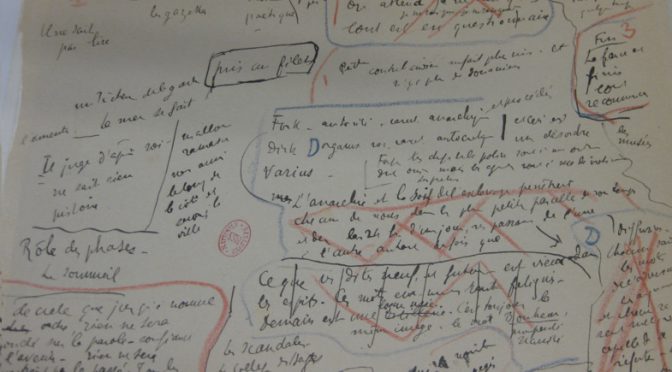
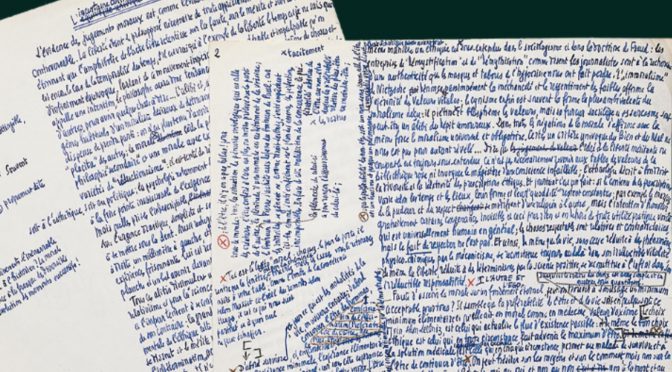
 A researcher at CNRS, Benedetta Zaccarello works on contemporary philosophy through the study of its manuscript documents and archives. Her work aims at understanding the part played by writing in the process of conceptual creation. Indeed, such an approach enables to uncover the existential, historical and cultural foundations of the protean set of thinking practices that form contemporary philosophy. It, thus, also aims to better understand texts and ideas themselves. Such a perspective shows that a philosopher is like a writer: rooted in culture, leading a dialogue with tradition, he/she negotiates between his/her own aspirations and his/her professional practice. Such dynamic, diachronic and genetical approach of the writing of philosophy has led Benedetta Zaccarello to study the forms, genres, and even literary strategies working through abstract texts, so to grasp the epistemic limits, the ambitions and the self-images built up by conceptual research in our contemporary times.
After working on Paul Valéry’s manuscripts (of which she has edited within an international research team the Cahiers 1894-1914 for Gallimard publishing house), as well on the manuscripts of Maurice Merleau-Ponty, Marguerite Duras and Michel Foucault, Benedetta Zaccarello has started to work on a yet unexplored aspect of the question of the expression of philosophy. Namely: the interference between various traditions happening in abstract writing.
As a researcher at CEFRES, she will mainly focus on exemplary case studies of philosophers who have dealt with various languages and traditions in their own philosophy. An intercultural phenomenon per se, philosophy has seen from the end of 19th century onward the multiplication of its paradigms, when the model of systematization, as best embodied by Hegel, started to wane. Within cultural traditions often considered as homogeneous, different ideas of what philosophy was unfolded: the practices of Western philosophy themselves are today divided in part by so-called analytical and continental types of writing. Thus, considering that such codes, styles and traditions constantly interact in contemporary philosophical creation, Benedetta Zaccarello aims to observe such intercultural mechanisms through the study of emblematic “mediator” philosophers such as Jan Patočka and Aurobindo Ghose.
CV
Researcher at CEFRES
PhD in Philosophy from the University Alma Mater Studiorum of Bologna and from “Blaise Pascal” University, Clermont-Ferrand II
Disciplines and leading research areas:
Forms and pratiques of abstract writing; Relationship between philosophy and literary criticism in 20th century France; Aesthetics, theories of literature and of reception; the history of contemporary philosophy; genetical criticism and author philology.
Teaching
2013-2016: Associate Professor at Charles University in Prague, Faculty of Human Sciences, Department of Semiotics and Electronic Culture
2006-2007: Assistant professor in Aesthetics, University Sidi Mohammed Ben Abdellah of Fès, Morocco
2008-2009: Assistant professor in Aesthetics, University IUAV of Venice, Italy
Collective Responsibilities
Member of the peer-review committee of the international periodical on aesthetics Aisthesis
Member of the scientific committee of the International Theatre Institut Italia
2010-2014: Co-organizer with Emmanuel de Saint Aubert (Archives Husserl, CNRS-ENS) of Qu’est-ce que la littérature ? Merleau-Ponty et la philosophie à l’épreuve de l’écriture (a series of international workshops and conferences).
2010-2013: Host of the seminar of genetics of the Valéry Team at ITEM
2006-2014: Co-editor of Paul Valéry, Cahiers 1894-1914, Paris, Gallimard
Grants
2016: Soutien à la mobilité internationale (SMI) of the CNRS for a research stay in Prague
2011: Award from the Institut Émilie du Châtelet
2009: Grant for the project “Research in Paris” of Mairie de Paris
2007: Vittorio Sainati Award: special award for a PhD on philosophy allotted by the presidency of Italy, the University of Pise and the ETS publishing house
2004: Fellowship at École thématique en critique génétique et analyse des manuscrits, ITEM (CNRS-ENS)/ IMEC, Abbaye d’Ardennes
2004: Vinci Grant from the French-Italian University of Grenoble/Torino for the PhD in international “cotutelle”
2003-2006: Grant from the Italian ministry of Education for the 3 years of the PhD in Aesthetic Philosophy at the Bologna University
2002: Grant from the Fondazione del Collegio San Carlo di Modena for the 2002 edition of “Festival Filosofia”
1999-2000: Erasmus grant from the University of Firenze for a research stay at Panthéon Sorbonne University (Paris I)
Publications
Monographies
- Marguerite Duras, La Chaise longue (édition annotée et commentée d’un scénario inédit. To be submitted).
- Funzione e Mistero di Paul Valéry: tracce dei Cahiers nella filosofia contemporanea, Pisa, Edizioni ETS, 2016 (forthcoming)
- Maurice Merleau-Ponty, Recherches sur l’usage littéraire du langage, Genève, MêtisPresses, 2012 (cours inédit au Collège de France, édité, annoté et commenté), 251 p.
- « Piccoli poemi astratti » : i Cahiers come progetto filosofico, Verona, Fiorini Edizioni, 2010, 149 p.
Edited books and collaborative publications
- Puissances et possibilités d’une île. Etudes sur un projet dramatique inédit de Paul Valéry : L’Isle sans nom, Benedetta Zaccarello and Franz Johansson (eds.), Paris, Classiques Garnier, 2016 (forthcoming) – edition, foreword.
- Du divin et des dieux : Recherches sur le Peri ton tou theou de Paul Valéry, Francfort/Main, Peter Lang, coll. “Rostocker Romanistische Arbeiten”, 2013, Benedetta Zaccarello, Franz Johansson and Fabienne Mérel (eds.) – edition, foreword, article.
- “Paul Valéry : strategie del sensibile”, numéro de Aisthesis, no. 1/2012, Benedetta Zaccarello, Jean-Michel Rey and Fabrizio Desideri (eds.) — edition, foreword, article. http://www.fupress.net/index.php/aisthesis/issue/view/842 –
- Paul Valéry, Cahiers 1894-1914, vol. X-XIII, Paris, Gallimard, 2006, 2009, 2012 and 2014.
- Enciclopedia Filosofica della Fondazione centro studi filosofici di Gallarate, Milano, Bompiani, 2006 (24 articles).
Selection of peer-reviewed articles
- « La poésie comme activité ‘spirituelle’ : sur la correspondance entre Aurobindo Ghose et Dilip Kumar Roy », in Crossed Correspondences: Writers as Readers and Critics of their Peers, Vanessa Guignery (ed.), Cambridge, Cambridge Scholars Publishing, 2016, pp. 98-117.
- « L’écriture de la philosophie : traces, pratiques, horizons », Littérature, 2015/2, no. 178, pp. 55-63.
- « La leçon au Collège de France. Notes sur la transmission orale des savoirs à partir de quelques avant-dire de Valéry, Merleau-Ponty et Foucault », Genesis, no. 39, 2014, pp. 71- 85. 27.
- « Paul Valéry : pour une logique organique du tracé » dans Genesis, no. 37, 2013, pp. 68-81. 26.
- « Que veut dire ‘Théta’ ? », in Du divin et des dieux : Recherches sur le Peri ton tou theou de Paul Valéry, Francfort sur le Main, Peter Lang, coll. « Rostocker Romanistische Arbeiten », 2013, pp. 289-306.
- « La philosophie et son double : notes sur Merleau-Ponty, Valéry et la littérature », in Du sensible à l’œuvre. Esthétiques de Merleau-Ponty, Bruxelles, La Lettre Volée, 2012.
- « Principes d’analogie pure et appliquée », Tangences, no. 95, Paul Valéry, identité et analogie, Winter 2011, pp. 29-41.
- « Valéry théoricien de la littérature selon Maurice Merleau-Ponty», in Paul Valéry et l’idée de littérature, conference proceedings of Paris Ouest University. http://www.fabula.org/colloques/document1422.php
- « Le ‘Drame intérieur’ et l’ ‘ornement’ dans les brouillons de l’Introduction à la méthode de Léonard de Vinci », in Valéry et Léonard : le drame d’une rencontre, Zürich, Peter Lang, coll. «Rostocker Romaistische Arbeiten», 2007, pp. 107-124.
- « L’Ombre de la pensée : individuation de la conscience et irréductibilité de l’individualité dans la stratégie philosophique des Cahiers », Bulletin des Etudes Valéryennes, no. 98, 2004, pp. 46-75.
- « Drame, Lutte, Tragédie : une symbolique théâtrale à l’œuvre dans le Cours de Poétique », Revue des Lettres modernes. Cahiers Paul Valéry : 10, pp. 95-133.
- « Alcuni modelli di rappresentazione del pensiero nei primi Cahiers di Paul Valéry », in Atti dell’Accademia di Scienze Morali e Politiche, Volume CXI – 2000, pp. 159-189.

 The main focus of my dissertation is a historical analysis of the concept of rebellion. I work with the theories of the Russian anarchists, Mikhail Bakunin, Pyotr Kropotkin, and the French philosopher Albert Camus, all of whom consider rebellion as originating from the notion of freedom. Beyond this common thread, I have discovered a deeper, so far not-fully explored, historical and conceptual connection, between Camus’s philosophy of rebellion the anarchist writings of Bakunin, and also Kropotkin.
  My dissertation project draws on the observation that the current global society revolves around the highly valued ideal of success. In addition, we can witness the declining ability to resign into passivity or doubt on the one hand, as well as the increasing tendency to lethargy where action proves vital on the other. In the broader scope of my research, I explore the notion of passivity in action, and claim it to be the foundation for living in meaningful relationships with others and the world. Specifically, I adhere to the idea of reinventing the understanding of activity according to its inherent uncontrollability, which appears to be present in each human act or relation. My research embarks from the most common situation, in which controllability is open for observations: from human failure.