10th session of CEFRES in-house seminar
Through the presentation of works in progress, CEFRES’s Seminar aims at raising and discussing issues about methods, approaches or concepts, in a multidisciplinary spirit, allowing everyone to confront her or his own perspectives with the research presented.
Location: CEFRES Library and online (to get the link, write to cefres[@]cefres.cz)
Date: Tuesday, June 10, 2025 at 4:30 pm
Language: English
Speaker: Honorata Sroka (CEFRES / Charles University)
Chair: Hélène Martinelli (CEFRES / École Normale Supérieure de Lyon)
Text to be read: Peter Bürger (1974). Theory of the Avant-Garde. Translation Michael Shaw. Manchester: Manchester University Press.
Abstract
The presentation will take the form of very preliminary remarks related to my post-doctoral research, which I have been conducting for 7 months at the French Research Centre for Humanities and Social Sciences. My project develops the same line of research as my doctoral thesis, however, approaches the issue in a broader way. Specifically, using selected examples of neo-avant-gardes in Central and Eastern Europe, I hope to show how and why artists decided to create subversive forms of historiography and what kind of experimental strategies can be found in archives. Employing the methodology so-called “cultural history of the avant-gardes”, I will reflect on vanguard institutions and practices oriented towards a self-historiography. What I dare to claim one can essentially call a discussion on Peter Bürger’s pivotal book Theory of the Avant-Garde (1974). He was the one who argued that the avant-gardes stood against institutions. In contrast to his assumption, my research aims to display how neo-avant-gardes in Central and Eastern Europe developed rather than destroyed art institutions, as well as subversive forms of historiography, and why these two were intertwined.
Please find the complete program of 2024–2025 seminar here.
Polish Communities in France and in the United States after WW2 and their Political Practices
9th session of CEFRES in-house seminar
Through the presentation of works in progress, CEFRES’s Seminar aims at raising and discussing issues about methods, approaches or concepts, in a multidisciplinary spirit, allowing everyone to confront her or his own perspectives with the research presented.
Location: CEFRES Library and online (to get the link, write to cefres[@]cefres.cz)
Date: Tuesday, May 27, 2025 at 4:30 pm
Language: English
Speaker: Florence Vychytil-Baudoux (EHESS / CEFRES)
Chair: Françoise MAYER
Text to be read: Michael Werner & Bénédicte Zimmermann, « Beyond Comparison: Histoire Croisée and the Challenge of Reflexivity », History and Theory, 2006, vol. 45, no 1, p. 30‑50.
Abstract:
Between the 1880s and the 1930s, over 12 million people left Polish territories “za chlebem” (for bread). While before WW1 the United States attracted most Polish peasants looking for a better future, it was France that became the main destination for Polish migrants in the interwar period. Continue reading Transatlantic Crossings | CANCELLED →
Eighth session of the 2024-2025 CEFRES Francophone
Interdisciplinary Seminar The Map and the Border
In 2023 we started questionning the very act of bordering and representing (a territory, a period, a trajectory). In short, thanks to the interdisciplinarity of our respective disciplines, we began inquiring into the question of the map and the border.
Location: CEFRES, Na Florenci 3, Prague 1
Date: Friday May 23, 2025, from 10 am
Language: French
Speaker: Gilles LEPESANT (CEFRES / CNRS)
Discussant: Barbora Kvasničková (Research fellow at AMO – Association for International Affairs)
Abstract Continue reading Energy and its Renewed Cartography →
Seventh session of the 2024-2025 CEFRES Francophone
Interdisciplinary Seminar The Map and the Border
In 2023 we started questionning the very act of bordering and representing (a territory, a period, a trajectory). In short, thanks to the interdisciplinarity of our respective disciplines, we began inquiring into the question of the map and the border.
Location: CEFRES, Na Florenci 3, Prague 1
Date: Friday April 25, 2025, from 10 am
Language: French
Speaker: Silvestr TRNOVEC (Institute of Oriental Studies, Slovak Academy of Sciences)
Discussant: Jakub ŠTOFÁNIK (Masaryk Institute and Archives, Czech Academy of Sciences)
Abstract Continue reading (Czecho)slovak History and French Colonial Space in Africa →
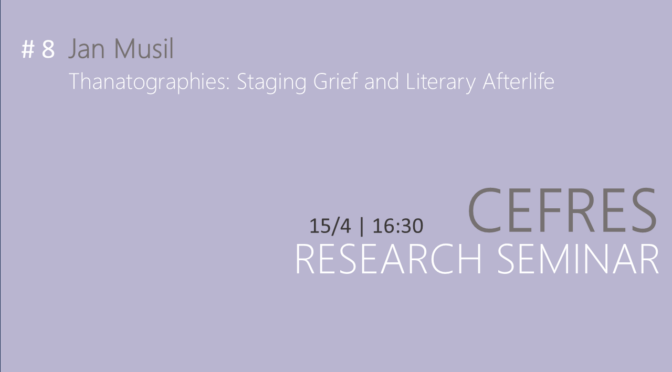
8th session of CEFRES in-house seminar
Through the presentation of works in progress, CEFRES’s Seminar aims at raising and discussing issues about methods, approaches or concepts, in a multidisciplinary spirit, allowing everyone to confront her or his own perspectives with the research presented.
Location: CEFRES Library and online (to get the link, write to cefres[@]cefres.cz)
Date: Tuesday, April 15, 2025 at 4:30 pm
Language: English
Jan MUSIL (Faculty of Arts, Charles University / associated at CEFRES)
Chair: Hélène Martinelli (CEFRES / École Normale Supérieure de Lyon)
Text to be read: Gorer, Geoffrey. “The Pornography of Death.” Encounter., vol. 5, no. 4, 1955.
Abstract:
With the christian idea of afterlife gradually fading away, 20th century rediscovered death as a real possibility and ultimate termination of individual life, only to make it into an insufferable, abjected topic and a taboo that is, as Geoffrey Gorer provocatively suggests in 1955, only accessible to the Western culture in hypertrophied genres of literature and film that he calls collectively the pornography of death. Continue reading Thanatographies. Staging Grief and Literary Afterlife →
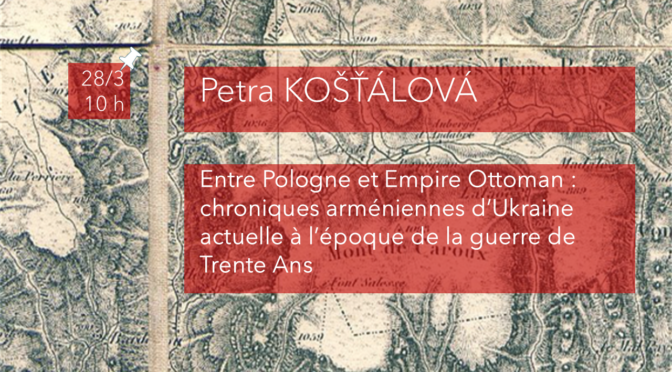
Between Poland and the Ottoman Empire: Armenian Chronicles from Ukraine during the Thirty Years’ War
Fifth session of the 2024-2025 CEFRES Francophone
Interdisciplinary Seminar The Map and the Border
Already in 2023, we started questionning the very act of bordering and representing (a territory, a period, a trajectory). In short, thanks to the interdisciplinarity of our respective disciplines, we began inquiring into the question of the map and the border.
Location: CEFRES, Na Florenci 3, Prague 1
Date: March 28, 2025, from 10am to 12pm
Language: French
Speaker: Petra Košťálová (Institute of Ethnology , Czech Academy of Sciences)
Discussant: Radu Paun (CERCEC/CNRS) & Laurent Tatarenko (CCFEF, Warsaw)
Abstract Continue reading Armenian Chronicles from Ukraine →
